Everyone’s talking about AI these days. In investing circles, “AI trading strategies” is the phrase that keeps coming up — on Reddit threads, finance YouTube channels, and LinkedIn posts from people who sound very confident about something most of us only half understand.
So let’s actually break it down. No jargon. No hype. Just a clear picture of what AI trading strategies are, how they work, who’s using them, and what this means for you as an everyday investor.

AI-powered investment analysis illustration showing Finqora mascot Byte reviewing portfolio data
First Things First — What Even Is an AI Trading Strategy?
At its core, an AI trading strategy is just a set of rules and decisions made by a computer program instead of a human.
The AI looks at huge amounts of data — price history, market trends, news sentiment, earnings reports, economic indicators — and uses that to decide when to buy, sell, or hold a position. It does this faster and with far more data than any human ever could.
Think of it like this: imagine you had an analyst who never slept, read every financial report ever published, tracked 10,000 stocks simultaneously, and made decisions in milliseconds. That’s roughly what AI trading systems do.
But here’s the thing most people miss — AI trading strategies aren’t one single thing. There are actually several different types, and understanding the difference matters.
The Main Types of AI Trading Strategies
1. Algorithmic Trading (Algo Trading)
This is the oldest form of AI-assisted trading. A set of predefined rules — “buy when the price crosses this moving average, sell when it drops below this threshold” — executes automatically. No human needs to press a button.
Algo trading is widely used by hedge funds and institutional investors and is responsible for a huge portion of daily market volume globally.
2. Machine Learning-Based Trading
This goes a step further. Instead of following fixed rules, machine learning models learn from data and adapt over time. They identify patterns humans wouldn’t notice and adjust their strategies based on new market conditions.
The more data they process, the smarter they get — in theory.
3. Sentiment Analysis Trading
Some AI systems scan news articles, social media posts, earnings call transcripts, and even central bank statements to gauge market “mood.” If the sentiment around a stock or sector shifts negative, the AI adjusts positions before the human crowd reacts.
4. High-Frequency Trading (HFT)
This is the extreme end — AI systems executing thousands of trades per second, profiting from tiny price differences across exchanges. This is largely the domain of massive financial institutions with serious infrastructure. Not something individual investors typically participate in directly.
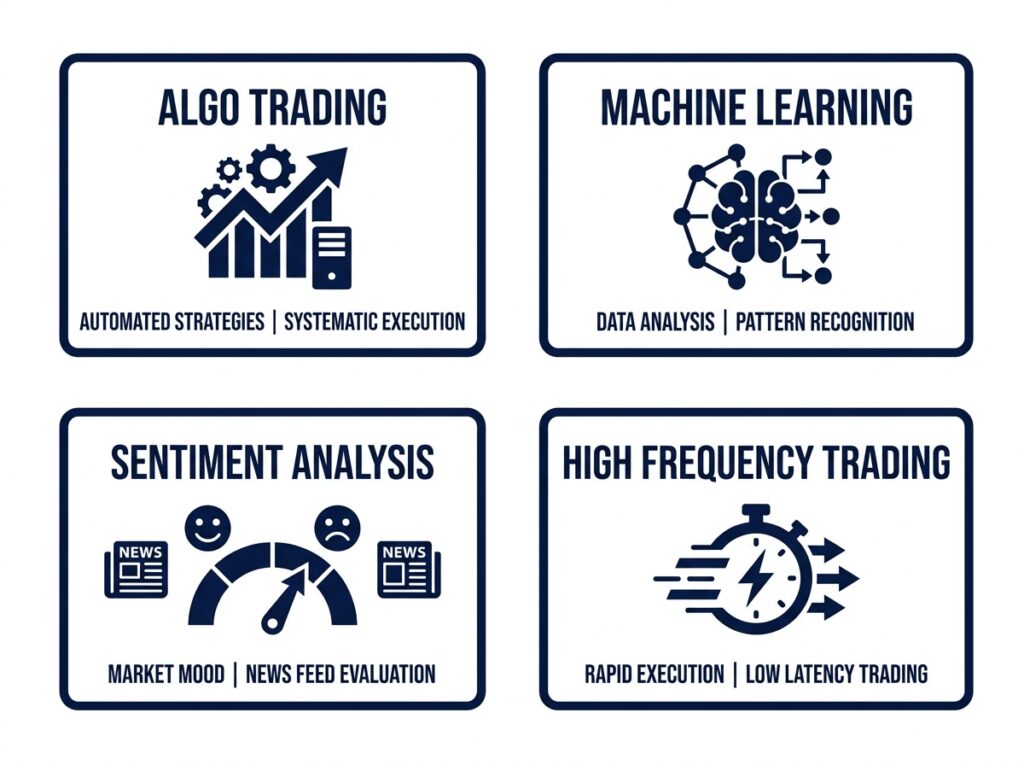
Four types of AI trading strategies explained — algorithmic, machine learning, sentiment analysis, and high frequency trading
So Should You Be Building AI Trading Strategies Yourself?
Honestly? Probably not — and here’s why.
Most AI trading systems at the institutional level require:
- Massive amounts of clean historical data
- Significant computing infrastructure
- Teams of quants and data scientists
- Constant monitoring and recalibration
The barrier to entry for building your own serious AI trading system is genuinely high. And the retail versions — apps promising “AI-powered trading” with a few taps — often oversimplify to the point of being misleading.
But here’s where it gets interesting for regular investors.
Where AI Actually Helps Everyday Investors the Most
The real value of AI for individual investors isn’t in automating trades. It’s in portfolio intelligence — using AI to understand your portfolio better than you ever could manually.
This is where tools like Finqora come in.
Rather than trying to replace your investment decisions, AI-powered portfolio builders help you:
→ See exactly what your portfolio is made of — sector by sector, asset by asset
→ Understand how your current allocation compares to common benchmarks
→ Spot hidden concentrations or risks you might not have noticed
→ Track how your portfolio is performing relative to your own strategy
This kind of clarity is genuinely powerful. Most investors have a rough idea of what they own, but they’ve never seen it laid out clearly with data. When you actually see your portfolio the way AI sees it — as a set of numbers, weights, and patterns — it changes how you think about your next move.

Young investor using Finqora AI portfolio builder to review investment allocation and performance
The Honest Truth About AI Trading Strategies and Returns
Here’s something the hype doesn’t tell you.
AI trading strategies are not magic. They don’t guarantee better returns. In fact, many AI-driven hedge funds have underperformed simple index funds over 5–10 year periods.
Why? A few reasons:
Markets Adapt
When an AI strategy starts generating returns, other participants notice the pattern and trade against it. The edge disappears.
Data Quality Matters Enormously
AI is only as good as the data it trains on. Bad data, biased data, or incomplete data leads to bad decisions — at machine speed.
Black Swan Events Break Models
COVID-19. The 2008 financial crisis. These were events that AI systems trained on historical data simply couldn’t predict. Many algorithmic systems failed badly during these periods.
This doesn’t mean AI is useless in investing. It means you should approach “AI trading strategy” claims with healthy scepticism — especially from apps or platforms promising consistent guaranteed returns.
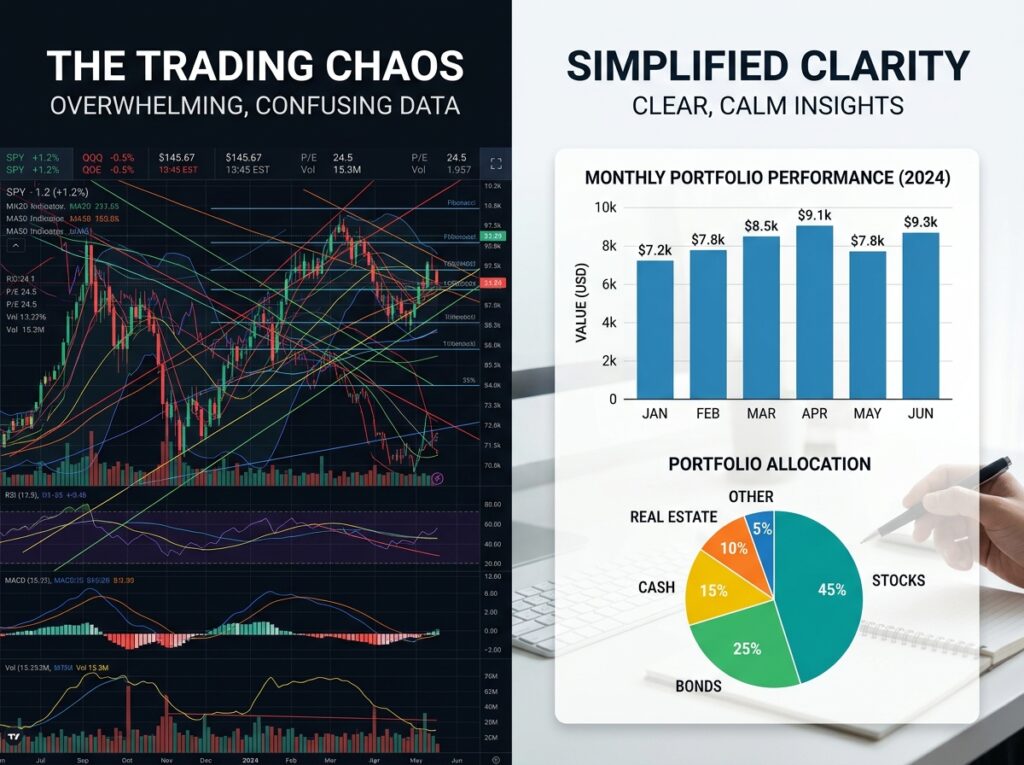
Comparison of complex AI trading data versus simplified portfolio clarity offered by Finqora
What to Actually Look for in an AI-Powered Investment Tool
If you’re evaluating any AI-powered investing platform, here are the questions worth asking:
Does It Explain Its Reasoning?
A good AI tool doesn’t just give you a recommendation — it shows you why. Transparency matters.
Does It Help You Understand Your Portfolio, or Does It Just Trade for You?
Tools that build your understanding are more valuable long-term than black-box systems you don’t control.
Is It Trying to Replace Your Judgment or Support It?
The best AI investing tools give you better information so you make better decisions. They’re not trying to take the wheel.
Does It Have a Clear Data Source?
Where is the AI getting its market data? How current is it? How is it processed?
[how to build your first portfolio or choosing the right investment platform]
A Practical Example: How AI Changes the Portfolio Review Process
Let’s say you’ve been investing for two years. You have a mix of mutual funds, a few individual stocks, and maybe some ETFs. You think you’re diversified.
Manually reviewing this — calculating your actual sector exposure, comparing performance against a benchmark, checking if your current allocation still matches your risk tolerance — could take hours. And most people just don’t do it.
With an AI-powered tool like Finqora, this becomes a 5-minute process. You input your holdings, and the AI maps out exactly what you own, how it’s weighted, and where the gaps or concentrations are. No spreadsheets. No manual calculation. Just clarity.
This is what AI trading strategy tools, at their best, do for regular investors. Not automating trades — giving you the kind of portfolio visibility that used to be reserved for people with expensive financial advisors.
The Bottom Line: Are AI Trading Strategies Worth It?
AI trading strategies are genuinely reshaping the investment world. At the institutional level, they’re driving a massive portion of daily market activity. At the individual investor level, the most practical application isn’t automated trading — it’s smarter portfolio understanding.
The investors who will benefit most from AI aren’t the ones trying to build their own algorithms. They’re the ones using AI-powered tools to see their portfolios more clearly, compare more intelligently, and make decisions with better information.
That’s not the flashy version of “AI trading strategies” you’ll find on clickbait finance channels. But it’s the version that actually works for most people.

Investor confidently reviewing AI-powered portfolio insights on Finqora portfolio builder
Build Your Portfolio with Finqora
Finqora is an AI-powered investment portfolio builder that helps you see, compare, and understand your portfolio — without the jargon.
Leave a Reply