To build an investment portfolio, start by defining your financial goals and understanding your risk tolerance. Next, choose an asset allocation across stocks, bonds, cash, and other investments, then diversify within each asset class. Invest consistently using strategies like dollar-cost averaging, and review your portfolio regularly to rebalance it as markets change. Beginners can start with low-cost index funds or ETFs and gradually expand their portfolios over time
Introduction

Diversified investment portfolio dashboard showing asset allocation across stocks, ETFs, mutual funds, bonds, cash, and cryptocurrency.
Building an investment portfolio can feel overwhelming when you’re staring at hundreds of stocks, ETFs, and mutual funds, wondering where to even start. The good news is that a solid investment portfolio doesn’t need to be complicated. It just needs a clear plan.
In this guide, you’ll learn exactly how to build an investment portfolio from scratch, why portfolio diversification matters, how asset allocation works, and what mistakes to avoid along the way. Whether you’re a complete beginner or someone looking to organize scattered investments across multiple brokerage accounts, this article walks you through the process step by step.
Quick Steps to Build an Investment Portfolio
If you’re looking for the shortest path to building an investment portfolio, follow these seven steps:
- Define your financial goals.
- Assess your risk tolerance.
- Decide on your asset allocation.
- Diversify across different asset classes.
- Choose suitable investment accounts and funds.
- Invest regularly using dollar-cost averaging.
- Review and rebalance your portfolio periodically.
These steps provide a simple framework for beginners while also forming the foundation of long-term portfolio management.
What Is an Investment Portfolio?
An investment portfolio is a collection of financial assets — such as stocks, bonds, ETFs, mutual funds, real estate, and cryptocurrency — that an individual or institution owns with the goal of growing wealth over time. Think of it as your personal basket of investments, each chosen to work toward a specific financial goal.
Investment Portfolio Meaning in Simple Terms
In simple terms, your investment portfolio is everything you own that has the potential to grow in value or generate income. It’s not just your stock holdings — it includes cash reserves, retirement accounts, crypto wallets, and any other asset you’ve invested money into.
What Is Portfolio Investment?
Portfolio investment refers to the act of purchasing financial assets — like stocks, bonds, or fund units — with the intention of earning returns, rather than taking direct operational control of a company. It’s different from a direct or strategic investment, where an investor might buy a controlling stake in a business.
Investment Portfolio Example
Here’s a simple investment portfolio example for a moderate-risk investor:
Asset Class — Allocation — Example Holdings
US Stocks — 40% — S&P 500 index fund
International Stocks — 15% — Global equity ETF
Bonds — 25% — Government and corporate bond funds
Cryptocurrency — 5% — Bitcoin, Ethereum
Cash/Emergency Fund — 15% — High-yield savings account
This is just one example. Your actual mix should reflect your goals, timeline, and comfort with risk.
Why You Need an Investment Portfolio (Not Just Random Investments)
Buying a stock here and a crypto token there isn’t the same as having an investment portfolio. Without structure, you end up with random bets instead of a strategy built to survive market ups and downs.
Benefits of Having a Structured Portfolio
A structured portfolio gives you:
- A clear picture of your total net worth and exposure to risk
- Protection against any single investment tanking your finances
- A framework for making decisions instead of reacting emotionally to market news
- Easier tracking of progress toward specific goals like retirement or a home purchase
Investment Portfolio Management Explained
Investment portfolio management is the ongoing process of selecting, monitoring, and adjusting your investments to match your goals and risk tolerance. It includes deciding your asset allocation, rebalancing when allocations drift, and reviewing performance regularly. You can manage this yourself, hire a financial advisor, or use a portfolio tracking tool that consolidates everything in one place.
How to Build an Investment Portfolio: Step-by-Step
Here’s exactly how to build an investment portfolio, broken into seven manageable steps.
Step 1 – Define Your Financial Goals
Start by asking what you’re investing for. Retirement in 30 years requires a different approach than saving for a house down payment in three years. Write down your goals with rough timelines and target amounts — this shapes every decision that follows.
Step 2 – Assess Your Risk Tolerance
Your risk tolerance depends on your age, income stability, financial obligations, and honestly, how well you sleep when the market drops. Younger investors with longer timelines can typically afford more risk, while those nearing retirement usually shift toward stability.
Step 3 – Choose Your Asset Allocation
Asset allocation is the process of dividing your money across different asset classes — stocks, bonds, cash, real estate, and alternatives like crypto. This single decision has more impact on your long-term returns than picking individual stocks.
Step 4 – Diversify Within Each Asset Class
Don’t stop at asset allocation. Within your stock allocation, spread investments across sectors, company sizes, and geographies. Within bonds, mix government and corporate options. This second layer of diversification reduces risk further.
Step 5 – Select Accounts & Brokerages
Choose the right account types for your goals — retirement accounts for tax advantages, taxable brokerage accounts for flexibility. Many investors end up with multiple accounts across different brokerages, which is normal but makes tracking harder.
Step 6 – Invest Consistently (Dollar-Cost Averaging)
Rather than trying to time the market, invest a fixed amount on a regular schedule. This strategy, known as dollar-cost averaging, smooths out the impact of market volatility over time.
Step 7 – Track, Monitor & Rebalance Your Portfolio
Once your portfolio is built, the work isn’t over. Markets shift, and your allocation will drift from your original targets over time. Regularly reviewing your holdings and rebalancing back to your target allocation keeps your risk level in check.

Investment portfolio rebalancing to maintain target asset allocation.
This is also where most people struggle — especially if your investments are spread across multiple brokerage accounts, crypto exchanges, and mutual fund platforms. A tool like Finqora consolidates all your holdings into a single dashboard, so you can see your real diversification and allocation at a glance instead of manually checking five different apps.
How to Build an Investment Portfolio for Beginners
Building an investment portfolio for beginners starts with simplicity. You don’t need ten different funds or complex strategies on day one — you need a small number of diversified, low-cost investments and the discipline to add to them consistently.
Building an Investment Portfolio for Beginners with Little Money
You can start an investment portfolio with as little as $50 to $100 using:
- Fractional shares of ETFs or index funds
- Robo-advisors that automatically diversify small amounts
- Micro-investing apps that round up purchases into investments
The amount matters less than starting the habit early.
Best Investment Portfolio for Beginners (2026)
For most beginners in 2026, a simple three-fund portfolio works well:
- A total US stock market index fund
- An international stock index fund
- A bond index fund
This combination offers broad diversification with minimal effort, low fees, and no need to pick individual stocks.
How to Build an Investment Portfolio for Beginners in India
Beginners in India can start with a mix of equity mutual funds, index funds tracking the Nifty 50 or Sensex, and debt mutual funds for stability. Systematic Investment Plans (SIPs) make it easy to invest small, fixed amounts monthly rather than a large lump sum. Many Indian investors also gradually add gold funds or international index funds for further diversification.
What Is Asset Allocation and Why Does It Matter?

Asset allocation illustration showing investments distributed across multiple asset classes.
Asset allocation is the process of dividing your investment portfolio among different asset classes—such as stocks, bonds, cash, real estate, and alternative investments—based on your financial goals, risk tolerance, and investment timeline.
It’s widely considered one of the most important decisions an investor makes because it determines how much risk your portfolio takes and how it is likely to perform over the long term. While individual investments matter, your overall asset mix often has a greater impact on long-term results than choosing the “perfect” stock or fund.
For example, a younger investor saving for retirement may allocate a larger portion to stocks for growth, while someone approaching retirement may increase their allocation to bonds and cash to reduce volatility.
Strategic Asset Allocation vs Dynamic Asset Allocation
Strategic asset allocation sets a fixed target mix (like 60% stocks, 40% bonds) that you maintain over the long term, rebalancing periodically back to those targets. Dynamic asset allocation, on the other hand, actively adjusts the mix based on changing market conditions or economic outlook. Strategic allocation is more passive and predictable; dynamic allocation requires more active management and market judgment.
What Is a Multi Asset Allocation Fund?
A multi asset allocation fund is a single fund that invests across multiple asset classes — typically equity, debt, and sometimes gold or commodities — within one portfolio. These funds aim to provide built-in diversification without requiring investors to manage multiple separate funds themselves.
Age-Based Asset Allocation Rule
A common starting rule is “100 minus your age” for your stock allocation percentage. A 30-year-old might hold 70% stocks and 30% bonds, while a 60-year-old might shift toward 40% stocks and 60% bonds. This isn’t a strict formula, but it’s a useful starting point.
Sample Asset Allocation Table by Risk Profile
| Investment Type | Risk Level | Return Potential | Best For |
| Stocks | High | High | Long-term growth |
| Bonds | Low to Moderate | Moderate | Income and stability |
| ETFs | Moderate | Moderate to High | Diversified investing |
| Mutual Funds | Moderate | Moderate | Hands-off investing |
| Cryptocurrency | Very High | Very High | High-risk investors with long investment horizons |
No investment is inherently “best.” The right mix depends on your financial goals, investment horizon, and tolerance for risk.
What Is Portfolio Diversification?

Portfolio diversification across industries, regions, and investment asset classes.
Portfolio diversification is the practice of spreading investments across different asset classes, sectors, and geographies so that poor performance in one area doesn’t sink your entire portfolio. It’s often summarized by the phrase “don’t put all your eggs in one basket.”
Portfolio Diversification Meaning
The meaning of portfolio diversification comes down to risk management: by holding a variety of investments that don’t all move in the same direction at the same time, you reduce the impact of any single investment’s decline on your overall wealth.
Why Portfolio Diversification Is Important
Portfolio diversification is important because it protects you from concentration risk — the danger of losing a significant portion of your money because it was tied up in one company, sector, or asset type. A diversified investment portfolio smooths out returns and reduces the emotional stress of watching a single holding swing wildly.
What Does Diversification Reduce in a Portfolio?
Diversification primarily reduces unsystematic risk — the risk specific to a single company, industry, or asset. It does not eliminate systematic risk, which affects the entire market, such as a recession or interest rate changes.
How Portfolio Diversification Reduces Risk
Diversification reduces risk because different assets react differently to the same economic event. When stocks fall, bonds often hold steady or rise. When one sector struggles, another may thrive. By holding a mix, losses in one area are often offset by stability or gains elsewhere.
Portfolio Diversification Strategies
There are several effective portfolio diversification strategies to apply as you build your holdings.
Diversifying Across Asset Classes
Spread your money across stocks, bonds, cash, real estate, and cryptocurrency. Each asset class behaves differently under various market conditions, which reduces your overall volatility.
Diversifying Across Sectors & Geographies
Within your stock holdings, avoid overconcentration in a single sector like technology. Add exposure to healthcare, finance, consumer goods, and international markets to reduce dependence on any one region or industry’s performance.
Diversifying Across Brokerage Accounts

Unified investment portfolio dashboard combining holdings from multiple brokerage accounts.
Many investors hold accounts across multiple brokerages — a retirement account here, a taxable account there, a crypto exchange elsewhere. While this is common, it can make it hard to see your true diversification. Consolidating a view of these accounts, even without moving the money itself, helps you spot overlaps and gaps in your allocation.
How Diversification Helps in Mutual Funds (MFs)
Diversification in mutual funds works by pooling money from many investors to buy a broad basket of stocks or bonds within a single fund. This gives even small investors instant diversification across dozens or hundreds of securities, something that would be expensive and time-consuming to build individually.
Benefits of Portfolio Diversification
The core benefits of portfolio diversification include:
- Reduced risk: Losses in one investment are offset by stability or gains in others
- Smoother returns: Less dramatic swings in your portfolio’s overall value
- Capital protection: Lower chance of catastrophic loss from a single bad investment
- Long-term compounding stability: A steadier growth curve supports consistent compounding over decades
Common Mistakes vs Best Practices
| Mistake | Better Approach |
| Investing in only one stock | Diversify across sectors |
| Ignoring asset allocation | Set a target allocation |
| Chasing market trends | Follow long-term goals |
| Never rebalancing | Review every 6–12 months |
| Using multiple apps without tracking | Use one portfolio dashboard |
Common Mistakes to Avoid When Building a Diversified Investment Portfolio
Even experienced investors fall into these traps:
- Over-concentration in one stock or sector, often because it performed well recently
- Ignoring rebalancing, letting winners grow into an outsized share of the portfolio
- Chasing trends instead of sticking to a long-term allocation strategy
- No goal alignment, investing without a clear connection to what the money is actually for
- Losing track of holdings spread across too many accounts and platforms
How Finqora Helps You Build & Manage Your Portfolio Automatically
Once your portfolio is built, keeping it diversified and on track is an ongoing job — especially if you’re investing across multiple brokerages, crypto exchanges, and mutual fund platforms. Finqora brings all of it into one place.
With Finqora, you can:
- Aggregate holdings from multiple brokerage accounts, crypto wallets, and mutual fund platforms into a single dashboard
- See your real asset allocation and diversification score at a glance, instead of manually calculating it across apps
- Get AI-driven insights on rebalancing opportunities based on your target allocation
- Track performance across your entire portfolio, not just one account at a time
Start building your diversified portfolio and let Finqora handle the tracking.
FAQ
- What is an investment portfolio? An investment portfolio is a collection of financial assets — such as stocks, bonds, ETFs, mutual funds, and cryptocurrency — owned by an individual or institution with the goal of growing wealth over time.
- What is portfolio investment? Portfolio investment is the purchase of financial assets like stocks or bonds to earn returns, without taking direct operational control of the underlying company, as opposed to a direct business investment.
- How to build an investment portfolio? Define your financial goals, assess your risk tolerance, choose an asset allocation, diversify within each asset class, select the right accounts, invest consistently, and rebalance regularly to keep your allocation on target.
- What is a portfolio investment scheme? A portfolio investment scheme is a regulated framework, often used by foreign or institutional investors, that allows investment in a country’s stock market or securities within set limits and reporting requirements.
- How do I check my investment portfolio? You can check your investment portfolio through each brokerage or fund platform’s app, or use a portfolio tracking tool like Finqora to view all your holdings, allocation, and performance in one consolidated dashboard.
- What is investment and portfolio management? Investment and portfolio management is the ongoing process of selecting, monitoring, and adjusting a mix of assets to meet specific financial goals while managing risk through diversification and periodic rebalancing.
- What is portfolio diversification? Portfolio diversification is the practice of spreading investments across different asset classes, sectors, and geographies to reduce the risk that any single investment significantly harms your overall portfolio.
- Why is portfolio diversification important? Portfolio diversification is important because it reduces concentration risk, smooths out returns over time, and protects your overall wealth from being heavily impacted by the poor performance of one investment.
- What does diversification reduce in a portfolio? Diversification reduces unsystematic risk — the risk tied to a specific company, sector, or asset — though it cannot eliminate systematic risk that affects the broader market.
- How does diversification help in mutual funds (MFs)? Diversification in mutual funds pools money from many investors to buy a broad basket of securities within one fund, giving even small investors instant exposure to dozens or hundreds of holdings.
- What is asset allocation? Asset allocation is the strategy of dividing an investment portfolio among asset categories like stocks, bonds, and cash, based on an investor’s goals, risk tolerance, and time horizon.
- What is the difference between strategic and dynamic asset allocation? Strategic asset allocation sets a fixed long-term target mix that’s periodically rebalanced, while dynamic asset allocation actively adjusts the mix in response to changing market conditions.
- What is a multi asset allocation fund? A multi asset allocation fund is a single fund that invests across multiple asset classes, such as equity, debt, and gold, providing built-in diversification within one investment.
- Which multi asset allocation fund is best? The best multi-asset allocation fund depends on your risk tolerance, investment horizon, and goals, so it’s worth comparing fund performance, expense ratios, and asset mix, or consulting a financial advisor, before choosing.
Key Takeaways
- Define clear financial goals before choosing investments.
- Match your asset allocation to your risk tolerance and investment timeline.
- Diversify across asset classes, sectors, and geographies to reduce unnecessary risk.
- Invest consistently instead of trying to time the market.
- Review and rebalance your portfolio periodically to maintain your target allocation.
- Track all your investments in one place so you always understand your overall portfolio and risk exposure.
Conclusion
Learning how to build an investment portfolio doesn’t require a finance degree — it requires a clear goal, a sensible asset allocation, real diversification, and the discipline to review and rebalance over time. Start simple, stay consistent, and let your strategy evolve as your knowledge and confidence grow.
Educational Disclaimer: This article is intended for educational purposes only and should not be considered personalized financial or investment advice. Investment decisions should be based on your individual financial situation, goals, and risk tolerance. Consider consulting a qualified financial advisor before making investment decisions.
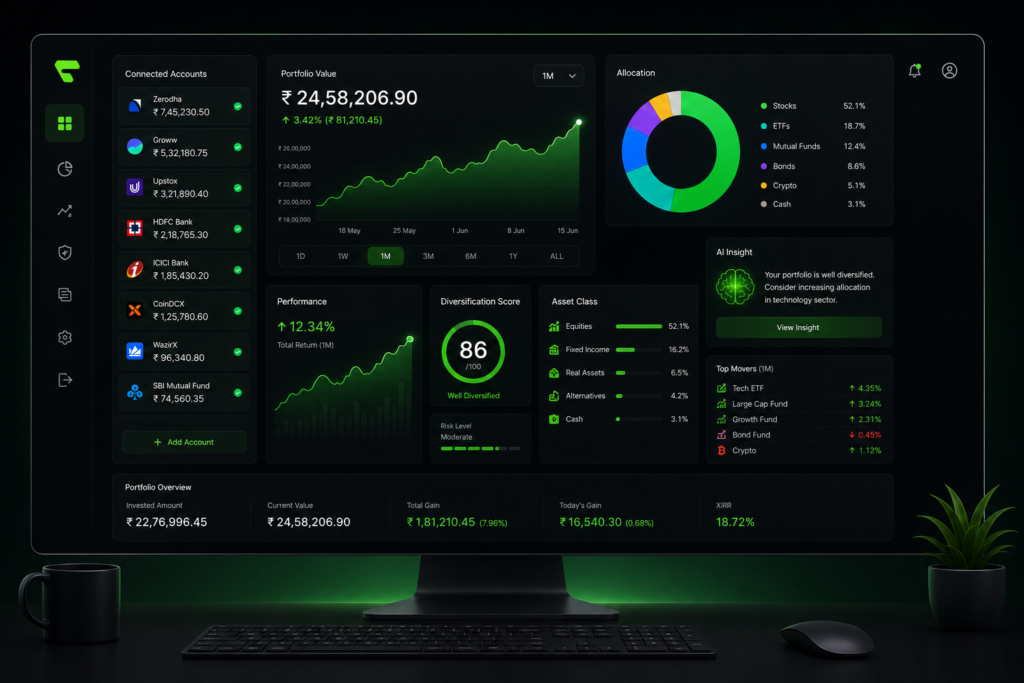
AI-powered investment portfolio dashboard showing diversification, asset allocation, and performance tracking.
Ready to Track Your Entire Investment Portfolio?
Building a diversified investment portfolio is only the first step. As your investments grow across multiple brokers, mutual fund platforms, and crypto exchanges, keeping track of everything becomes increasingly difficult.
Instead of switching between multiple apps, use Finqora to view your complete portfolio in one dashboard. Monitor your asset allocation, analyze your diversification, track performance across accounts, and receive AI-powered insights that help you stay aligned with your long-term investment goals.
Start tracking your portfolio with Finqora and make smarter investment decisions with a complete view of your wealth.
Leave a Reply