Published by Finqora | AI Portfolio Builder
| Table of Contents 1. Introduction 2. What Is Investing? 3. Step-by-Step Guide on How to Start Investing 4. How AI is changing investing for beginners 5. Example Portfolios Generated Using AI 6. Common Investing Mistakes Beginners Make 7. Frequently Asked Questions 8. Conclusion |
1. Introduction
What if the single best financial decision you could make today costs less than a dinner out?
Most people believe investing is reserved for the wealthy, the financially educated, or those with large sums of money sitting in a bank account. The truth is the opposite. Learning how to start investing is one of the most accessible and high-impact steps any person can take toward financial independence — regardless of income, background, or experience.
In India alone, over 80% of household savings sit in low-yield instruments like fixed deposits and savings accounts, according to the Reserve Bank of India. Meanwhile, the global stock market has historically delivered average annual returns of around 10% over the long term (S&P 500 historical data, Vanguard). The gap between where your money is and where it could be working for you is enormous.
This beginner’s guide will walk you through everything you need to know about how to start investing — in plain language. You will learn what investing actually is, how much money you need, how to avoid the most common mistakes, and how modern AI investing tools are making it easier than ever for beginners to build wealth with confidence.
Let us begin.
Why Investing Matters

Young Indian investor learning how to invest money for beginners on a laptop, exploring stock market and personal finance concepts.
Inflation in India has averaged around 5–6% per year over the last decade (RBI data). That means ₹1 lakh kept in a savings account quietly loses real purchasing power every year. Investing is how you stay ahead of inflation and build long-term wealth.
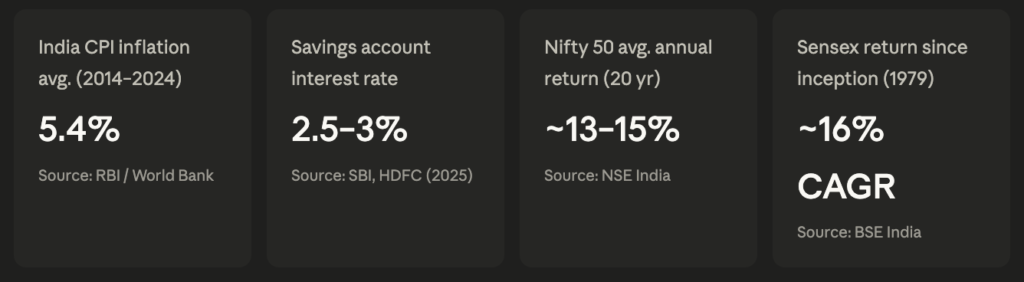
| DATA INSIGHT According to AMFI India, the number of SIP accounts crossed 10 crore in 2024 — proof that ordinary Indians are already making regular investing a habit. You should too. |
2. What Is Investing?
Investing means putting your money into assets — like mutual funds, stocks, gold, or real estate — with the expectation that they will grow in value over time. Unlike saving, which preserves your money, investing actively grows it.
- Stocks: ownership in a company; high potential return, higher risk
- Mutual funds / index funds: pooled money managed professionally or passively
- Bonds / debt funds: lower risk, steady fixed returns
- Gold: inflation hedge, low correlation to equity
- Real estate: tangible asset, high entry cost
| PRO TIP For beginners in India, a Nifty 50 index fund via SIP is one of the simplest and most proven ways to start investing. Low cost, diversified, and historically strong returns. |
Why Most People Delay Investing
Research from Fidelity and local surveys consistently shows the same reasons beginners postpone investing:
“I don’t have enough money yet.”
“The market is too risky.”
“I don’t understand how it works.”
“I’ll start next month.”
| BEGINNER MISTAKE Waiting for the “perfect time” to invest is the single most expensive mistake beginners make. Every year you delay costs you years of compound growth you can never get back. |
The good news: AI has removed all of these barriers. You can start with ₹500, let the AI assess your risk, and get a portfolio in under 5 minutes.
How Much Money Do You Need to Start Investing?

Indian rupee coins growing into a money tree, symbolizing how to invest money for beginners, investment growth, and long-term wealth creation.
This is the question almost every beginner asks first.
The honest answer: less than you think.
Here are practical entry points for Indian beginners:
| Investment Type | Minimum to Start |
| Mutual Fund SIP | ₹100-₹500/month |
| Direct Stock (NSE/BSE) | ₹1 share (some as low as ₹5) |
| Index Fund ETF | Price of 1 unit (often ₹50–₹500) |
| Digital Gold | ₹1 |
| NPS (National Pension System) | ₹500/month |
| US Stocks via Fractional Shares | ₹100 via apps like INDmoney |
| DATA INSIGHTA Vanguard study found that starting with small amounts consistently outperforms waiting to invest a larger lump sum. Consistency beats size. ₹2,000/month started at 25 beats ₹10,000/month started at 35. |
The Power of Compound Growth
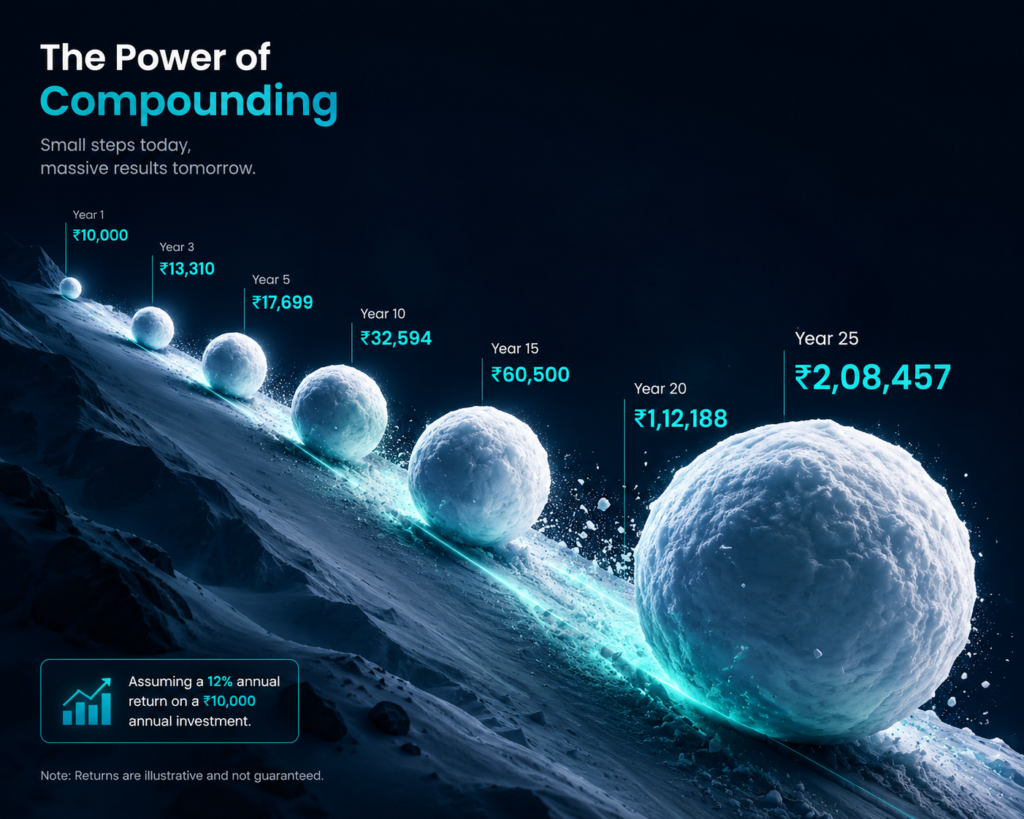
Compound interest visualization explaining how to invest money for beginners in India and grow wealth through long-term investing
Compound growth means your returns earn returns. Over 20–30 years, this becomes extraordinary. Here is what ₹2,000, ₹5,000, and ₹10,000 per month looks like at a conservative 12% annual return (approximate historical Nifty 50 SIP average, AMFI data):
| Monthly SIP | 10 years | 20 years | 30 years | Total invested (30 yr) |
| ₹2,000/month | ₹4.6L | ₹19.8L | ₹70.5L | ₹7.2L |
| ₹5,000/month | ₹11.6L | ₹49.5L | ₹1.76Cr | ₹18L |
| ₹10,000/month | ₹23.2L | ₹99L | ₹3.52Cr | ₹36L |
| Assumptions: 12% annual return, monthly compounding. Past performance of Nifty 50 SIP does not guarantee future returns. Source: AMFI SIP return calculator methodology. |
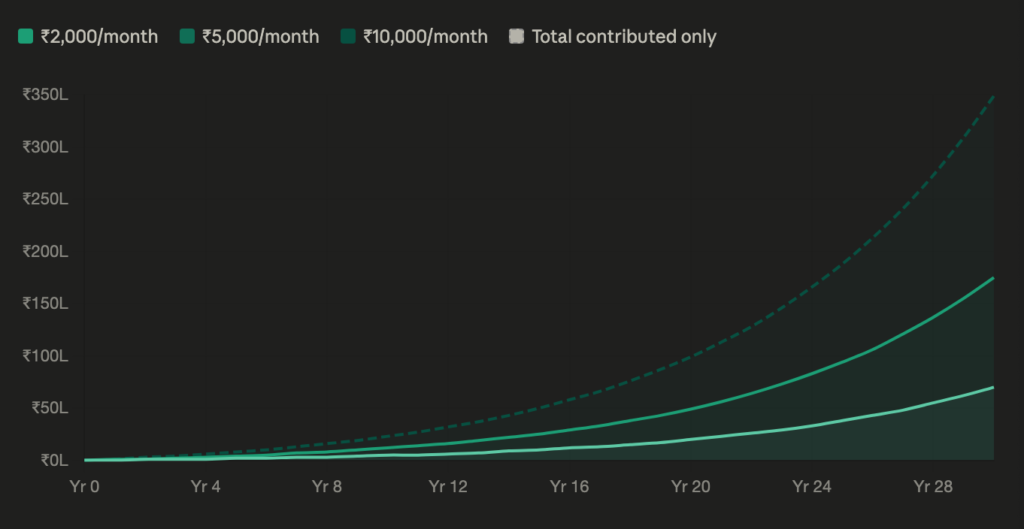
Graph 1 — Compound SIP growth over 30 years. The gap between money contributed and portfolio value widens dramatically after year 15 — this is compound growth in action. Source: AMFI SIP calculator methodology, 12% assumed return.
3. Step-by-step guide: how to start investing
Now comes the practical part. Here is a clear, actionable roadmap for any beginner.
| Step 1: Set Financial GoalsBefore investing a single rupee, get clear on why you are investing.Ask yourself:Am I investing for retirement?Am I saving for a home down payment in 5 years?Am I building an emergency wealth buffer?Am I creating a college fund for my child?Your goal determines your investment horizon, which in turn determines how much risk you should take.Short-term goals (1–3 years): Low-risk instruments like liquid funds, short-term FDs, or debt mutual funds. Medium-term goals (3–7 years): Balanced funds, hybrid mutual funds, or a mix of equity and debt. Long-term goals (7+ years): Equity-heavy portfolios, index funds, direct stocks. |
| Step 2: Build an Emergency Fund FirstThis step surprises many beginners — before investing, build a buffer.An emergency fund of 3–6 months of living expenses, kept in a high-yield savings account or liquid mutual fund, ensures you never have to sell your investments during a market downturn just to cover unexpected expenses. |
| 💡PRO TIP Your investments are long-term vehicles. If you do not have a financial cushion, a medical emergency or job loss will force you to exit your investments early — often at a loss. |
| Step 3: Understand Your Risk ToleranceRisk tolerance is your ability — both financial and emotional — to handle drops in your investment value.Three broad investor profiles:Conservative: Prioritizes capital preservation. Prefers bonds, debt funds, gold. Lower returns, lower volatility.Moderate: Balanced approach. Mix of equity and debt. Accepts some volatility for better growth.Aggressive: Comfortable with high volatility in exchange for maximum long-term returns. Heavy equity exposure.Your age, income stability, financial dependents, and personal temperament all influence which profile suits you best. |
| Step 4: Choose the Right Investment AccountIn India, your options include:Demat + Trading Account: Required to invest in stocks and ETFs. Offered by Zerodha, Groww, Upstox, Angel One, and others.Mutual Fund Account: Open directly with fund houses like HDFC, SBI, Mirae, or through apps like Groww, Coin by Zerodha, or MF Central.NPS Account: For retirement-specific investing with tax benefits under Section 80CCD.ELSS Mutual Funds: Tax-saving equity funds under Section 80C. |
| Step 5: Start Small and Build ConsistencyBegin with an amount you will not miss each month. Consistency matters far more than size at this stage.A ₹2,000 SIP invested every month for 30 years at 10% returns = ₹45.7 lakhs. That is the power of starting small but starting now. |
| Step 6: Diversify Your PortfolioNever put all your money in a single stock, sector, or asset class.Diversification means spreading your investment across:Different asset classes (equity, debt, gold)Different sectors (technology, healthcare, FMCG, banking)Different geographies (domestic + international index funds)Diversification does not eliminate risk but significantly reduces the impact of any single investment performing poorly. |
| Step 7: Invest Consistently and Review PeriodicallySet up automatic monthly SIPs so you invest without needing to remember or make active decisions. Review your portfolio every 6–12 months to ensure it still aligns with your goals and risk profile. |
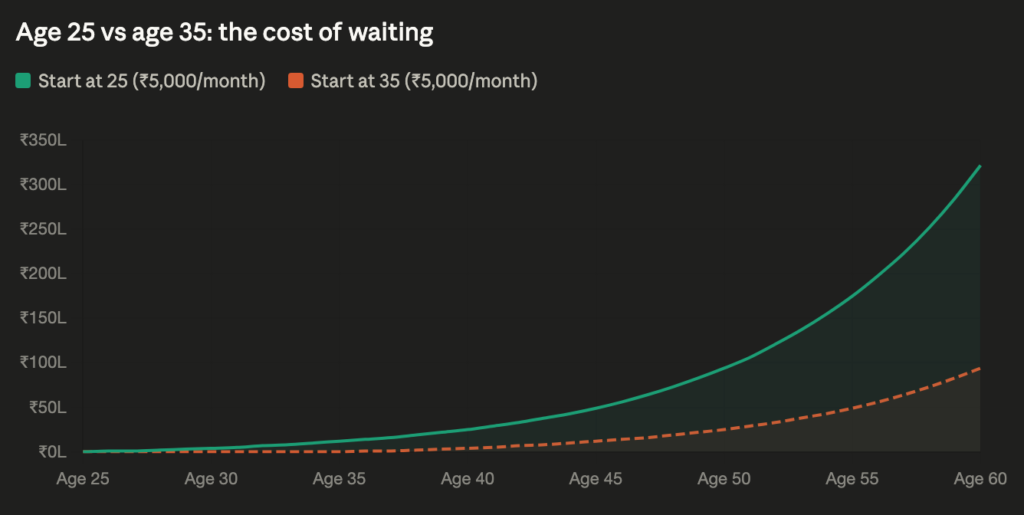
Graph 2 — Starting 10 years earlier more than triples your final corpus. Both invest ₹5,000/month at 12% until age 60. Starting at 25: ~₹3.2 Cr. Starting at 35: ~₹88L. Source: compound interest formula, 12% annual rate.
4. How AI is changing investing for beginners
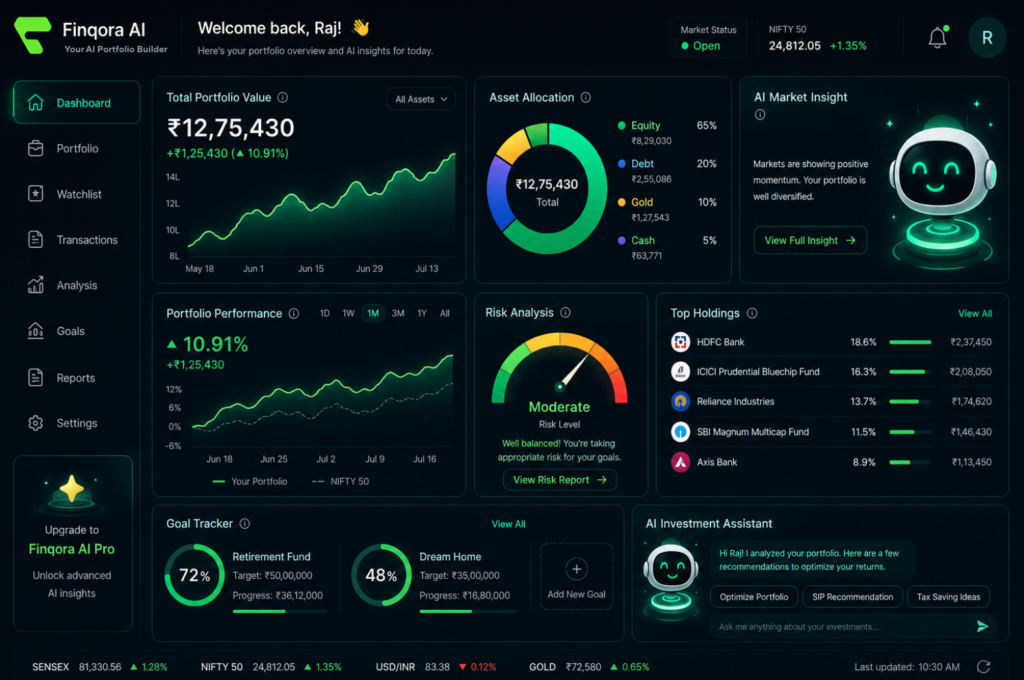
AI portfolio builder dashboard showing investment tracking and asset allocation for people learning how to invest money for beginners in India
Traditionally, professional investment advice cost 1–2% of your assets annually — thousands of rupees a year. AI has democratized this completely.
AI analyzes thousands of data points (fund performance, expense ratios, market conditions) in seconds
Removes emotion — no panic selling during market dips
Provides 24/7 portfolio monitoring with real-time alerts
Explains every recommendation in plain language
Costs up to 98% less than a human advisor (PortfolioPilot data, 2025)
| DATA INSIGHTAI-based portfolio platforms tracked over $40 billion in assets globally as of May 2026 (PortfolioPilot). In India, robo-advisor AUM grew over 4x between 2021 and 2025 (SEBI data). |
What is an AI portfolio builder?
An AI Portfolio Builder is a digital tool that uses artificial intelligence and machine learning algorithms to create, manage, and optimize an investment portfolio tailored specifically to you.
Unlike traditional robo-advisors that follow rigid rule-based models, modern AI portfolio builders use dynamic algorithms that:
- Process your financial goals, income, and risk tolerance
- Analyze historical market data and current economic indicators
- Generate a personalized, diversified portfolio recommendation
- Continuously monitor and suggest rebalancing when needed
Think of it as having a personal financial advisor available 24/7 — but one that processes data at a scale no human could match and that charges a fraction of the cost.
How an AI Portfolio Builder Helps Beginners
Risk Assessment
The AI begins by understanding your risk profile through a series of questions about your age, income, financial goals, time horizon, and comfort with market volatility. Based on your answers, it assigns you a risk score and builds a portfolio calibrated to your actual risk appetite — not a generic template.
Portfolio Recommendations
Using your risk profile, the AI recommends a specific allocation of your money across asset classes — for example, 60% large-cap equity funds, 20% mid-cap funds, 10% debt funds, and 10% gold ETFs. These recommendations are backed by historical performance data and forward-looking indicators.
Diversification Suggestions
The AI automatically ensures your portfolio is diversified — across sectors, market caps, and geographies — reducing concentration risk without requiring you to understand what each fund does in detail.
Goal-Based Investing
You can set specific goals within the platform — retirement at 60, child’s education in 15 years, home purchase in 5 years — and the AI will create separate, targeted investment strategies for each goal, showing you projected outcomes under different scenarios.
Automated Insights and Portfolio Adjustments
As markets shift and your financial situation evolves, the AI monitors your portfolio and flags when rebalancing is needed. Instead of passively watching your money, you have an intelligent system working on your behalf.
AI portfolio tools available to Indian investors
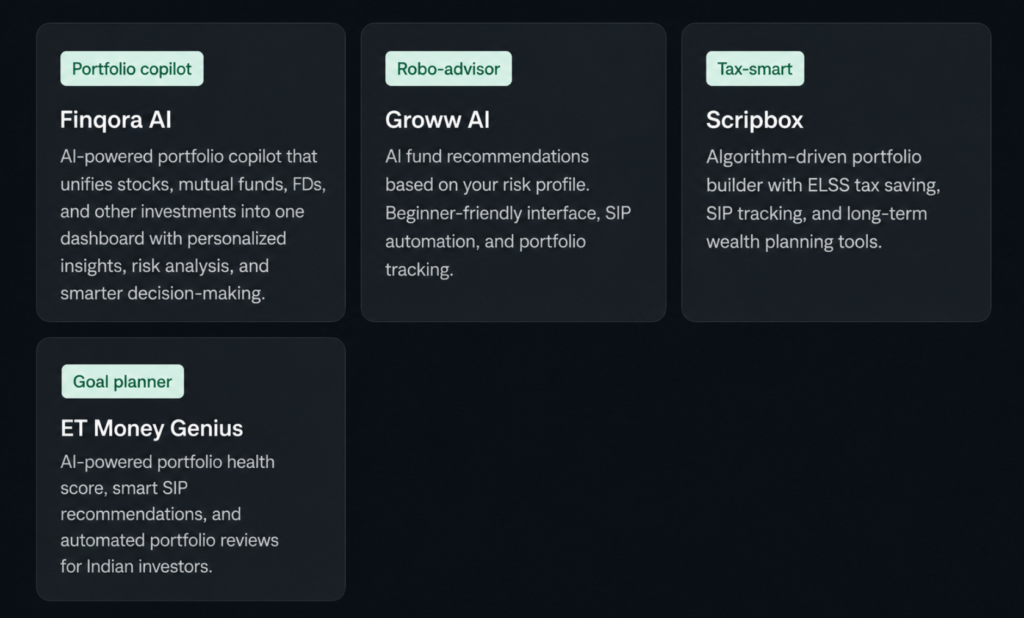
Infographic showcasing AI portfolio tools available to Indian investors. Each offering personalized investment insights and portfolio management features.
5. Example portfolios generated using AI
The following are illustrative AI-generated portfolio examples based on different risk profiles for a 28-year-old Indian investor with a 15-year horizon.
CONSERVATIVE PORTFOLIO — Monthly Investment: ₹5,000
| Asset Class | Allocation | Fund Type Example |
| Large-Cap Equity Funds | 30% | Nifty 50 Index Fund |
| Short-Term Debt Funds | 35% | HDFC Short Term Debt Fund |
| Gold ETF | 20% | Nippon India Gold BeES |
| Liquid Fund | 15% | SBI Liquid Fund |
Projected value at 15 years (6% blended return): Approximately ₹20.9 lakhs
MODERATE PORTFOLIO — Monthly Investment: ₹5,000
| Asset Class | Allocation | Fund Type Example |
| Large-Cap Equity Funds | 50% | Mirae Asset Large Cap Fund |
| Mid-Cap Equity Funds | 20% | Axis Midcap Fund |
| Debt / Hybrid Funds | 20% | ICICI Prudential Balanced Advantage |
| Gold ETF | 10% | SBI Gold ETF |
Projected value at 15 years (9% blended return): Approximately ₹31.2 lakhs
AGGRESSIVE PORTFOLIO — Monthly Investment: ₹5,000
| Asset Class | Allocation | Fund Type Example |
| Large & Mid-Cap Equity | 60% | Kotak Emerging Equity Fund |
| Small-Cap Equity | 20% | Nippon India Small Cap Fund |
| International Index Fund | 15% | Motilal Oswal Nasdaq 100 ETF |
| Gold ETF | 5% | UTI Gold ETF |
Projected value at 15 years (12% blended return): Approximately ₹45.9 lakhs
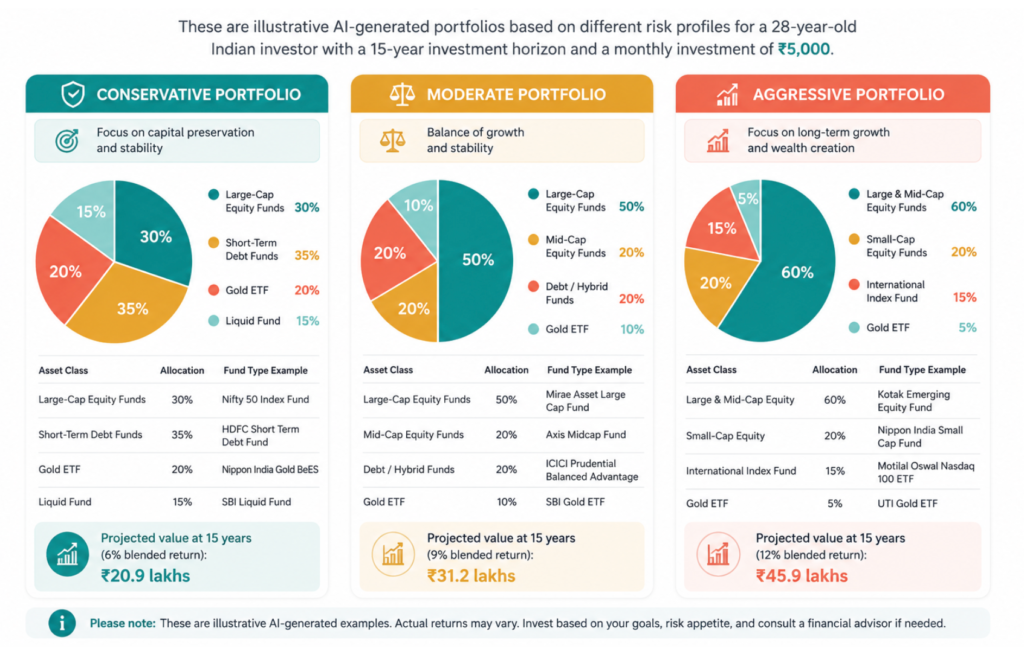
Infographic comparing conservative, moderate, and aggressive AI-generated investment portfolios showing asset allocation and projected 15-year returns.
Historical returns: savings vs bonds vs stocks
Graph 3 — Historical return comparison: ₹1 lakh invested for 20 years. The equity gap is dramatic, Sources: RBI data for savings/FD rates; NSE India for Nifty 50 historical 20-year CAGR.
6. Common Investing Mistakes Beginners Make
Even with the best intentions, beginners often fall into predictable traps. Here are the most costly ones — and how to avoid them.
BEGINNER MISTAKE BOX 1:
Investing Without a Goal
Investing randomly without a defined goal leads to random outcomes. Every investment should serve a specific purpose with a clear timeline.
BEGINNER MISTAKE BOX 2:
Panic Selling During Market Dips
Markets fall. They always have and they always will — temporarily. According to Vanguard (2023), investors who stayed invested through every major market correction in the last 30 years outperformed those who exited and re-entered by an average of 4–6% annually.
BEGINNER MISTAKE BOX 3:
Chasing Past Performance
A fund that returned 40% last year is not guaranteed to repeat that this year. Morningstar research consistently shows that past performance is one of the weakest predictors of future returns.
BEGINNER MISTAKE BOX 4:
Ignoring Expense Ratios
A 1% difference in expense ratio between two funds might seem small. Over 20 years, that 1% can consume hundreds of thousands of rupees in your returns. Always compare expense ratios before choosing funds.
BEGINNER MISTAKE BOX 5:
Waiting for the Perfect Moment
Time in the market beats timing the market — this is one of the most well-documented principles in investing history. Start now, start small, and build from there.
BEGINNER MISTAKE BOX 6:
Not Reviewing Your Portfolio
An aggressive portfolio is appropriate at 25 but not at 55. As you approach your goals, gradually shift to less volatile assets. Review your portfolio at least once a year.
7. Frequently Asked Questions
Q1: How do I start investing as a complete beginner in India?
Start by setting a clear financial goal, building an emergency fund, and then opening a mutual fund account through a reliable platform like Groww, Zerodha Coin, or MF Central. Begin with a SIP of even ₹500–₹1,000 per month in an index fund. Consistency is more important than the amount at the beginning.
Q2: How much money do you need to start investing?
In India, you can start investing with as little as ₹100 per month through a mutual fund SIP. Digital gold starts at ₹1. Stocks can be bought for the price of a single share, which for some companies is under ₹50. There is no minimum wealth requirement to begin.
Q3: Is AI investing safe for beginners?
AI investing tools and AI portfolio builders help beginners make data-backed decisions rather than emotional ones. They do not guarantee returns — no investment tool can — but they significantly reduce the risk of uninformed decision-making. Always ensure the platform is SEBI-registered or affiliated with SEBI-registered advisors.
Q4: What is the best investment for a beginner with ₹5,000 per month?
For most beginners, a low-cost Nifty 50 or Nifty Next 50 index fund SIP is an excellent starting point. It offers automatic diversification across the 50–100 largest Indian companies at a very low cost. Over time, you can add mid-cap and international funds as your knowledge and confidence grow.
Q5: How does an AI portfolio builder work?
An AI portfolio builder collects information about your financial goals, risk tolerance, investment horizon, and income. It then uses machine learning algorithms to recommend a diversified portfolio across asset classes, continuously monitors performance, and suggests adjustments as market conditions or your situation changes.
Q6: Can I lose money by investing?
Yes — all investing carries some risk of loss, especially in the short term. Stock markets go up and down. However, historically, diversified equity portfolios held over 10 or more years have delivered positive real returns in virtually every major global market. The key risk-management tools are diversification, time, and discipline.
Q7: What is the difference between saving and investing?
Saving means setting aside money in low-risk, low-return vehicles like savings accounts or FDs. Investing means allocating money into assets that carry more risk but offer the potential for significantly higher long-term growth. Saving protects money; investing grows it.
8. Conclusion
Learning how to start investing is not about being perfect. It is about starting.
The biggest wealth-building advantage any beginner has is time — and every day you wait is a day of compound growth that you cannot get back.
The good news is that you do not need large sums of money, a finance degree, or access to expensive advisors. With as little as ₹500 per month and the right tools — including modern AI portfolio builders that remove the guesswork and personalize your strategy — you can begin building wealth today.
Here is what to take away from this guide:
- Start as early as possible, even with small amounts.
- Set clear, specific goals and match your investments to them.
- Understand your risk tolerance before choosing any investment.
- Diversify across asset classes and sectors.
- Use consistent monthly SIPs to harness compound growth.
- Let AI investing tools do the heavy analytical lifting — especially when you are starting out.
- Avoid emotional decisions; review your portfolio calmly once or twice a year.
The journey to financial independence begins with a single step. You now have the knowledge. The only thing left is the decision.
Start investing today — not next month, not next year. Today.
Leave a Reply