Introduction
If your money is scattered across two demat accounts, a mutual fund app, a gold SIP, fixed-income investments, and a crypto exchange, getting a clear picture of your portfolio can become surprisingly difficult. Each platform may show its own holdings and returns, but looking at accounts separately makes it harder to understand how your investments fit together as a whole.
A portfolio tracker for multiple accounts helps solve this problem by bringing your investments into a consolidated view.
For investors who want to organize holdings across different asset classes, a free online portfolio builder can also provide a structured way to build and view investments as one portfolio.
Instead of switching between platforms or maintaining complicated spreadsheets, you can see how your money is distributed across different assets, understand your overall allocation, track performance, and identify areas where your portfolio may be more concentrated than you intended.
However, not every portfolio tracker works the same way. Some automatically connect with supported brokers and financial accounts, while others let you build and manage a consolidated portfolio across different asset classes in one place. The right choice depends on what you own, how much automation you need, and which portfolio insights matter most to you.
In this guide, we’ll explain how to track investments across multiple accounts, what to look for when choosing a portfolio tracker, the difference between automatic account aggregation and consolidated portfolio tracking, and how platforms like FINQORA can help you organize and understand investments spread across multiple asset categories.
Why Tracking Investments Across Accounts Is Harder Than It Should Be
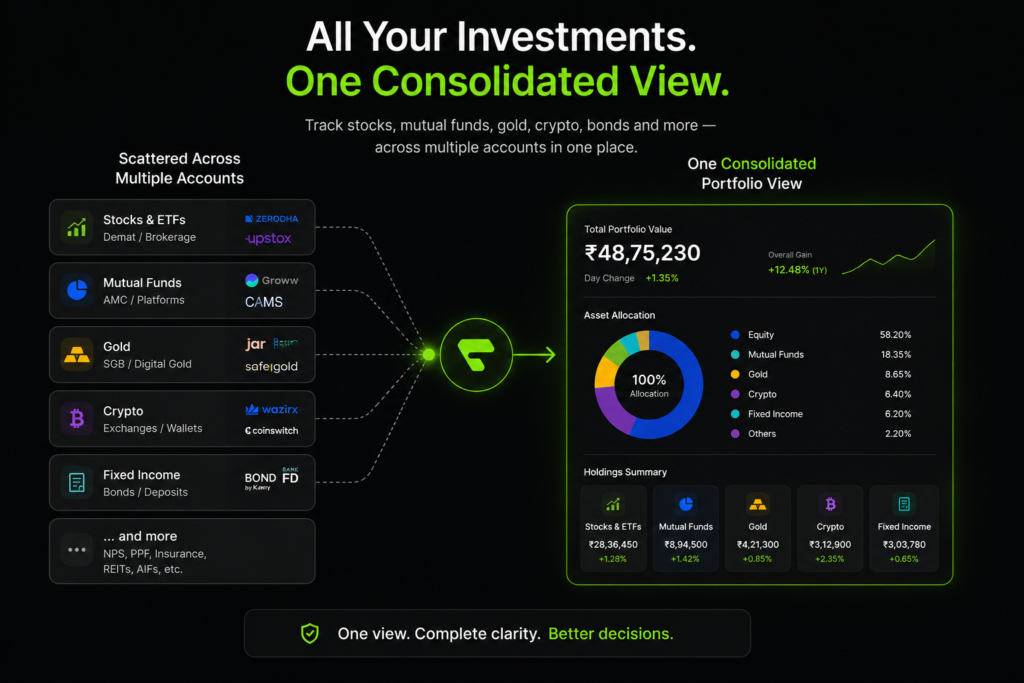
Multiple investment accounts consolidated into one portfolio view
Most Indian investors don’t plan to end up with five different apps open just to check their net worth. It happens gradually — one demat account from your first job, another because a broker offered zero brokerage, a mutual fund SIP through a different platform, some gold bonds bought during a festive offer, and maybe a crypto wallet you opened out of curiosity.
Each app shows you its own slice. None of them show you the whole plate. That makes basic questions surprisingly hard to answer: How much of my money is in equity versus debt? Am I overexposed to one sector because three of my mutual funds hold the same large-cap stocks? What’s my actual return, blended across everything?
This is where tools designed to track all investments in one place become useful — bringing scattered holdings into a consolidated view so you can understand your overall allocation, performance, and exposure without analyzing every account separately.
Why Portfolio Risk Matters When Tracking Multiple Accounts
Tracking investments across multiple accounts is not just about knowing your total portfolio value. When your money is spread across demat accounts, mutual funds, gold, fixed-income investments, crypto, and other assets, looking at each account separately can hide risks that only become visible when you view everything together.
Portfolio risk refers to the possibility that your combined investments may lose value or behave differently than expected because of factors such as asset allocation, concentration, volatility, and correlation between holdings.
For example, you might own technology stocks in one demat account and several equity mutual funds in another. Viewed separately, both accounts may appear reasonably diversified. But when you look at your investments as one portfolio, you may discover that a significant portion of your money is exposed to the same sector or group of companies.
This is one reason a portfolio tracker for multiple accounts can be useful. A consolidated view helps you understand not only how much you own, but also how your investments are distributed across your overall portfolio.
Portfolio risk can also change over time as some investments grow faster than others, causing allocation drift to gradually change your portfolio risk even if you make no new investments.
What Does “Portfolio at Risk” Mean?
Portfolio at risk broadly refers to how much of a portfolio could be exposed to potential losses under certain market conditions. One commonly used quantitative measure for estimating potential portfolio losses is Value at Risk (VaR).
VaR estimates how much a portfolio could potentially lose over a specified period at a given confidence level, based on a particular model and its assumptions.
For example, suppose a ₹10 lakh portfolio has a one-day 95% VaR of ₹15,000. This does not mean ₹15,000 is the maximum possible loss. It means the model estimates that losses would exceed ₹15,000 on roughly 5% of days, assuming the model and its underlying assumptions hold.
VaR is useful as a risk-estimation tool, but it is not a guarantee. Extreme market events, sudden changes in volatility, liquidity problems, and rising correlations between assets can result in losses significantly larger than the estimate.
How Value at Risk (VaR) Is Calculated
A simplified parametric Value at Risk formula can be expressed as:
VaR ≈ Portfolio Value × Z-score × Portfolio Volatility × √Time
Where:
Portfolio Value is the current total value of the portfolio.
Z-score represents the selected confidence level under the model being used.
Portfolio Volatility estimates how much the portfolio’s returns fluctuate over time.
Time represents the selected measurement period, adjusted according to the assumptions of the model.
In practice, calculating portfolio risk can be more complicated because investments do not move independently. The volatility of individual assets, their portfolio weights, and the correlations between them can all affect overall portfolio risk.
This becomes especially important when investments are spread across multiple accounts. An asset that looks insignificant in one brokerage account may represent a much larger exposure once all your investments are considered together.
How to Calculate Portfolio Weight
Portfolio weight tells you what percentage of your total portfolio is represented by a particular investment or asset class.
The basic portfolio weight formula is:
Portfolio Weight = Value of Individual Investment ÷ Total Portfolio Value
For example, suppose you have ₹10 lakh invested across multiple accounts and ₹2 lakh is invested in one mutual fund:
₹2,00,000 ÷ ₹10,00,000 = 20%
That mutual fund therefore represents 20% of your total portfolio.
Portfolio weight matters because the same price movement can have very different effects depending on the size of a position. A 10% decline in an investment representing 5% of your portfolio will have a much smaller overall impact than a 10% decline in an investment representing 40%.
This is where tracking multiple investment accounts together becomes particularly useful. Instead of judging positions based on how large they appear within an individual demat or investment account, you can evaluate their weight against your entire portfolio.
A consolidated portfolio view can make it easier to identify unintended concentration, understand your overall asset allocation, and see how investments held across different accounts fit together. Portfolio weight and asset allocation also play an important role when building a diversified investment portfolio, since true diversification depends on both what you own and how much you allocate to each investment.
Two Ways to Track Multiple Investment Accounts in One Place
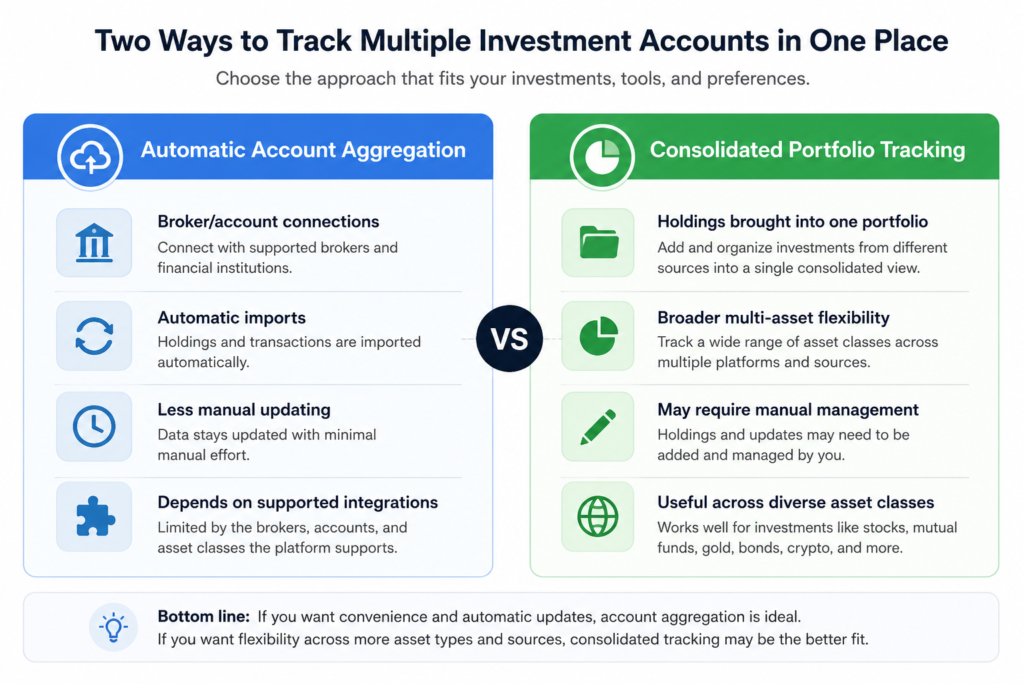
Automatic account aggregation vs consolidated portfolio tracking for multiple investment accounts
There are two main ways to bring investments held across different accounts into a single portfolio view: automatic account aggregation and consolidated portfolio tracking.
Automatic account aggregation
Automatic account aggregation connects a portfolio tracker with supported brokers or financial institutions and imports account information automatically. This can reduce manual work and keep holdings updated, but its usefulness depends on which brokers, account types, and asset classes the platform supports.
Consolidated portfolio tracking
Consolidated portfolio tracking lets you bring holdings from different sources into one portfolio without relying entirely on direct broker integrations. This approach can be useful when your investments are spread across asset types that may not all exist within the same financial platform, such as stocks, mutual funds, gold, fixed-income products, crypto, and other investments.
Neither approach is automatically better. If convenience and automatic updates are your priority, broker connectivity may matter most. If you want to organize investments across a wider range of asset classes, multi-asset coverage and portfolio-level analytics may be more important.
Before choosing a tracker, check how holdings are added and updated, which asset classes are supported, and whether the platform provides the analysis you actually need.
What to Look For in a Portfolio Tracker for Multiple Accounts
Not every “tracker” actually tracks. Some are glorified watchlists. Before picking one, check whether it covers these basics:
| What to check | Why it matters |
|---|---|
| Account import method | Check whether holdings sync automatically, can be imported, or need to be added manually |
| Multi-asset coverage | Make sure the tracker supports the investments you actually own |
| Consolidated view | Helps you see investments across accounts as one overall portfolio |
| Allocation breakdown | Shows how your portfolio is distributed across asset classes and investments |
| Performance insights | Helps you understand returns beyond individual account balances |
| Portfolio analytics | Provides additional insight into allocation, concentration, risk, or other portfolio metrics |
| Watchlists | Keeps investments you’re researching separate from investments you own |
| Security and privacy | Especially important when a platform connects to financial accounts |
| Pricing transparency | Makes it clear which tracking and analytics features are free or paid |
A stock-only portfolio tracker may not solve the full problem if your investments extend beyond equities. If you also hold mutual funds, gold, fixed-income products, crypto, international stocks, or other assets, multi-asset coverage becomes an important factor when choosing a tracker.
Where FINQORA Fits: Multi-Asset Portfolio Tracking
FINQORA is an AI-powered portfolio builder and tracker designed for investors whose investments span multiple asset classes. It supports portfolio building and tracking across 23 asset categories, including NSE/BSE stocks, global stocks, ETFs, mutual funds, cryptocurrency, gold and silver, commodities, forex, bonds, fixed deposits, PPF and government savings, NPS, Sovereign Gold Bonds, and more.
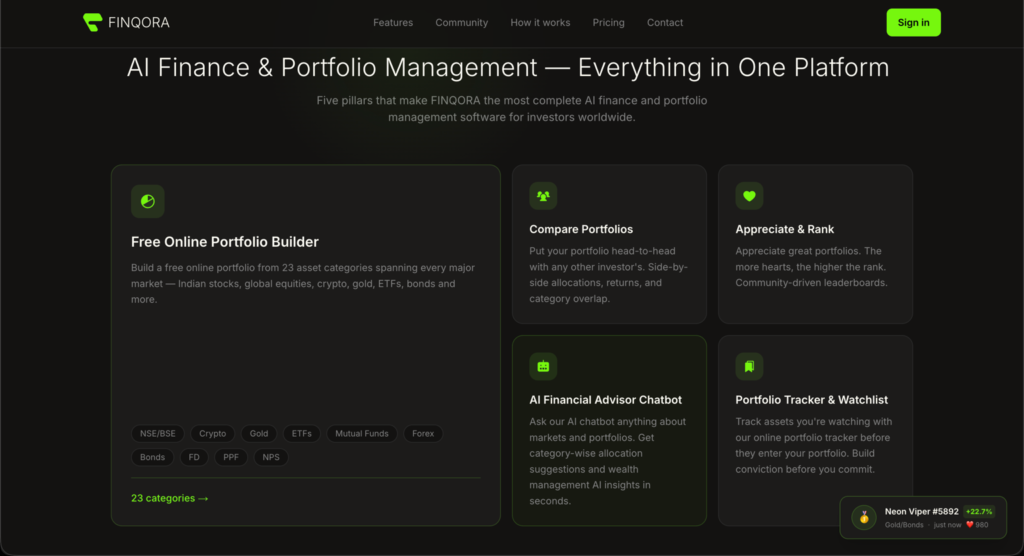
Finqora multi-asset portfolio builder and investment tracking features
Rather than viewing each asset class separately, users can bring their investments into a consolidated portfolio and better understand how their money is distributed across different categories. FINQORA also provides portfolio comparison features, allocation and return insights, watchlists, and tools for exploring portfolio risk.
An important distinction is how holdings are consolidated. FINQORA does not currently automatically sync holdings from external brokerage or demat accounts. Instead, users build and manage their portfolios within the platform. This makes it different from automatic account aggregators that connect directly to supported financial institutions.
FINQORA also includes an AI Portfolio Assistant for exploring category-wise portfolio and market insights. Users can ask questions about markets, portfolio allocation, and investment categories, making the AI feature more of an analytical and research companion than an automated investment manager. If you’re exploring this technology for the first time, our guide to using AI for investing explains what AI investment tools can and cannot realistically do.
The platform also adds a community dimension to portfolio tracking. Users can discover and compare portfolios, appreciate portfolios they find interesting, and participate in community leaderboards. This makes FINQORA particularly suited to investors who want to combine multi-asset portfolio tracking, AI-assisted exploration, and community-based portfolio discovery in one platform.
FINQORA Pricing
FINQORA offers a free plan for getting started and a Pro plan for users who need more portfolios, AI access, and advanced features.
| Free | Pro | |
| Price | ₹0 Forever | ₹150/month Billed annually |
| Portfolios | 1 portfolio | Unlimited |
| AI Assistant | 3 AI credits/day | Unlimited AI chat |
| Search | Basic search | Advanced search & filters |
| Watchlists | Limited | Unlimited |
| Export & analytics | — | ✓ Included |
| Support | Community support | Priority support |
| Ideal for | Getting started | Multiple portfolios & advanced features |
| Start free. No credit card required. Build your first portfolio and explore FINQORA before upgrading to Pro. |
Common Mistakes Investors Make When Tracking Multiple Accounts
Even investors who genuinely try to stay on top of things fall into a few predictable traps.
Treating “total value” as the whole picture. Watching your net worth go up feels productive, but total value tells you nothing about concentration. You could be up 12% for the year while 60% of that gain sits in a single mid-cap stock you never meant to overweight. Without a breakdown by asset class and individual holding, growth and risk look identical on the surface.
Ignoring overlap between mutual funds. It’s common to hold three or four equity mutual funds thinking you’ve diversified, only to find that all of them have significant positions in the same handful of large-cap names. You end up paying multiple expense ratios for what is functionally one concentrated bet. Overlap analysis exists specifically to catch this, but almost nobody checks for it manually.
Rebalancing based on feeling instead of numbers. “This sector is due for a correction” is a hunch, not a rebalancing strategy. Weight and risk figures give you an actual threshold to act on — for example, trimming a holding once it crosses a set percentage of your total portfolio, rather than reacting to headlines.
Forgetting non-market-linked assets exist in the portfolio too. Fixed deposits, PPF, NPS, and Sovereign Gold Bonds don’t move day to day, so they’re easy to leave out of the mental math entirely. But they still affect your real asset allocation — often pulling your effective risk lower than your equity-only view suggests.
Checking too often, adjusting too little of substance. Daily price-checking tends to produce emotional decisions, not better ones. The investors who actually improve their allocation over time are usually the ones reviewing monthly or quarterly, using weight and risk data rather than daily price swings, to decide what to change.
How to Start Tracking Multiple Investment Accounts
Once you’ve chosen how to consolidate your investments, follow these steps to build a complete portfolio view:
- List every investment account you hold. Include old demat accounts, mutual fund platforms, fixed-income investments, gold, crypto, and any accounts you rarely check.
- Choose one place to consolidate your portfolio. Decide whether you need automatic account syncing or a platform where you can build and manage a consolidated portfolio yourself.
- Include every relevant asset class. Add stocks, mutual funds, ETFs, gold, bonds, fixed-income investments, crypto, and other holdings to get an accurate view of your overall allocation.
- Check allocation and concentration. Look at how much each investment, asset class, or sector represents across your entire portfolio, not just within one account.
- Review your portfolio periodically. Check for meaningful changes in allocation, concentration, and performance based on a schedule that fits your investment strategy.
- Look beyond returns when making decisions. Consider portfolio weight, allocation, concentration, diversification, and risk alongside performance.
Frequently Asked Questions
What is the easiest way to track multiple investment accounts in one place?
Use a portfolio tracker that lets you consolidate investments from different accounts into one portfolio view. Depending on the platform, holdings may be automatically synced from supported financial accounts or added and managed within the tracker. Choose one that supports the asset classes you actually own.
What should I look for in a portfolio tracker for multiple accounts?
Look for broad asset coverage, a consolidated portfolio view, allocation and performance insights, portfolio analytics, clear pricing, and a convenient way to add or update holdings. If automatic syncing is important to you, also check which brokers and financial institutions the tracker supports.
Can I track stocks, mutual funds, gold, and other investments together?
Yes, if you use a multi-asset portfolio tracker that supports those investment categories. Tracking different asset classes together can give you a clearer picture of your overall allocation than viewing each investment account separately.
Can I track multiple demat accounts in one place?
Yes, but how it works depends on the tracker. Some platforms automatically connect with supported brokers or financial accounts, while others let you manually consolidate holdings from multiple demat accounts into a single portfolio.
What is the difference between portfolio risk and Value at Risk (VaR)?
Portfolio risk is a broad concept covering factors such as volatility, concentration, asset allocation, and correlation between investments. Value at Risk (VaR) is a specific statistical measure used to estimate potential portfolio losses over a defined period at a given confidence level. VaR is an estimate based on assumptions, not a maximum-loss guarantee.
Do I need to calculate portfolio weight manually?
Not necessarily. Portfolio weight is calculated by dividing the value of an individual investment by the total portfolio value. Portfolio tracking and analytics tools may calculate allocation percentages automatically based on the holdings entered into the platform.
Is a free portfolio tracker enough?
It depends on your needs. A free tracker may be sufficient for basic portfolio building and tracking, while paid plans may offer additional portfolios, advanced analytics, AI features, exports, or other tools. Compare the features rather than choosing based on price alone.
Does FINQORA automatically sync brokerage or demat accounts?
No. FINQORA currently lets users build and manage a consolidated portfolio within the platform rather than automatically syncing holdings from external brokerage or demat accounts. It supports portfolio building and tracking across 23 asset categories, with a free plan available to get started.
Conclusion
Tracking investments across multiple accounts becomes much easier when you can see your holdings as one portfolio instead of switching between different apps and platforms. A consolidated view can help you better understand your overall allocation, performance, concentration, and risk.
The right portfolio tracker for multiple accounts depends on what matters most to you, whether that is automatic account syncing, broad asset coverage, portfolio analytics, or a simple way to organize investments in one place.
If your investments span multiple asset classes, FINQORA lets you build and track a consolidated portfolio across 23 asset categories, with portfolio insights, AI-assisted exploration, and comparison features available in one platform.
Leave a Reply